
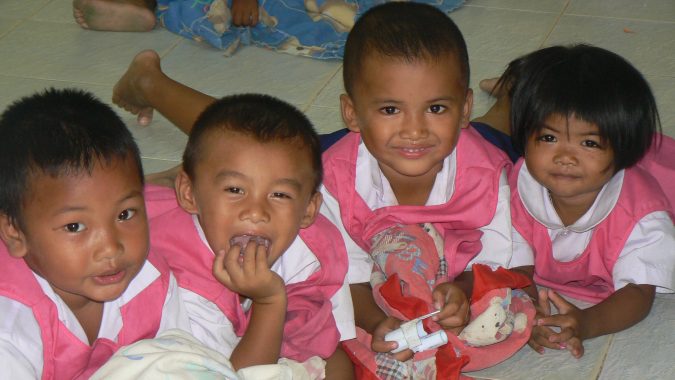
FXB was very active in Thailand from 1990 to 2012 and has carried out numerous programmes to combat poverty, build the capacity of vulnerable communities and families and prevent HIV/AIDS. Specific educational programmes continue to be carried out, on a voluntary basis, by members of the committee of its small local branch.
Our action in Thailand
1. Emergency Home FXB
In 1990, FXB opened two emergency house FXB in Bangkok, in partnership with the SCRC and MSFto collect girls escaped from brothels or evacuated by the police. Very quickly, a third FXB House is opened in Chiang Mai and a fourth in Chiang Rai. This programme has since been taken over by a local NGO.
In 1992, FXB opened 4 FXB Houses for orphans, HIV-positive children and AIDS patients in Chiang Mai province. They offer more than just medical care, they are based on the concept of Tender Loving Care : the belief that these children will have a better and longer life if they are accommodated in a family setting, surrounded by tenderness and cared for (FXB also implemented this concept of Tender Loving Care Colombia, Brazil and the United States).
The opening of these Houses also represents a significant position in the fight against stigmatization and discrimination against these children and is an alternative to access to palliative care for young residents. As soon as antiretrovirals were available in the region, FXB's strategy was – as with all FXB Houses – to hand this project over to a local NGO, namely the Support for Children Foundation, so that it could be fully dedicated to other development projects in Thailand.
2. Prevention programmes
As early as 1990, FXB also launched HIV/AIDS prevention, education and awareness programmes on human and child rights in Bangkok, Buriram province, and through a local radio station in the mountainous areas where the Akha live.
3. Hospice of palliative care for AIDS patients
From 1993 to 1995, FXB – in partnership with the monk Ahra Alingar (PRA ALONGOT ) – supported the launch of a pioneer hospice in the Buddhist temple in Lopburi whose vocation was to welcome AIDS patients at the end of their life. This hospice, providing medical and spiritual support to the sick to help them live and die with AIDS, is now run by the Dhammaraksanives Foundation.
4. Rescue operation for prostitutes
In 1994, a national committee – made up of representatives of the Thai government, of NGOs (including FXB) and of bodies such as theUNICEF,International Labour Organization (ILO) andInternational Organization for Migration (IOM) – was formed to launch a comprehensive national action plan to combat prostitution and trafficking in human beings in Thailand.
This committee was set up following the rescue operation launched in 1992 by Albina du Boisrouvray, FXB's Founding President, and Senator Secuturee Chutikul, at the time Advisor to the Prime Minister of Thailand and responsible for the status of women and child prostitution. In July 1992, the Association received a call for assistance from girls working on the border between Thailand and Burma. These young women were subjected to sexual slavery, beatings, undernourished and highly exposed to HIV/AIDS. Albina du Boisrouvray alerts then Seizee Chutikul. The police raided and released 153 women and girls, including 95 young Burmese. Aged 14-20, 50% of them are HIV-positive. They will be repatriated to their home country a few months later. In September 1993, FXB launched a pilot project which offered individualised reintegration, based on the aspirations, abilities of each of these young women and the opportunities of the economic market. Myanmar.
5. Tsunami reconstruction
In 2005, following the December 2004 tsunami, FXB invested in a boat reconstruction project for fishermen. « Mokens » and held over a year of psychosocial support sessions in schools in Phuket and Phangnga.
6. Addressing the multidimensional causes of poverty: 5 community and economic development projects VillageFXB
In response to the spread of the AIDS pandemic, including the capacity of families and communities to accommodate more orphans and children affected by the disease, FXB has also decided to replicate its VillageFXB poverty reduction model in Thailand, the results of which are very positive in Africa.
From 2006 to 2012, FXB conducted 5 VillageFXB programmes in the provinces of Buriram and Maha Sarakham. These programmes have enabled more than 2,000 children and adults to achieve economic and social autonomy, to have a positive impact on their communities and to live a dignified life in their country. In particular, they provided opportunities for vulnerable grandparents to protect and raise AIDS and tsunami orphans they had collected.

Our impact in Thailand

were conducted in the provinces of Buriram and Maha Sarakham from 2006 to 2012.

have achieved economic and social autonomy and a positive impact on their community and a dignified life in their country.

Through its interventions, FXB also helped to pave the way for an improvement of Thai national legislation through the « Law on the Prevention and Punishment of Trafficking in Women and Children » (1997).