
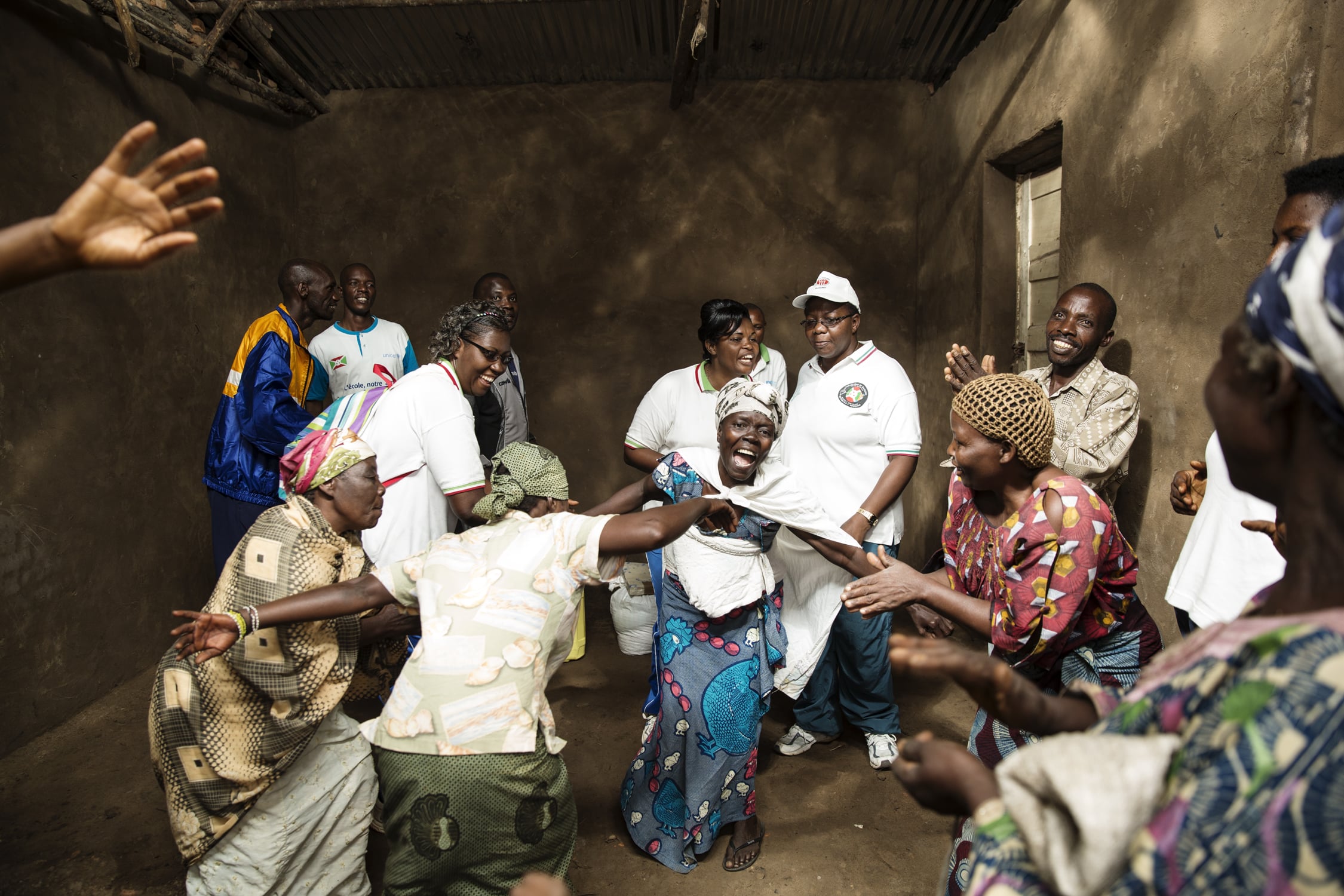
Since 2006, FXB Switzerland has been actively working for the sustainable development and improvement of the living conditions of the most vulnerable communities in Burundi, where it is recognized and registered locally as an international non-governmental organization.
Context
Burundi remains one of the poorest countries in the world, with persistent challenges in terms of access to education, health and sustainable sources of income for its population. Political, social and economic crisis, food insecurity, malaria epidemic, fuel shortages or recurrent floods, this country is facing a major humanitarian crisis.
Nearly 3/4 of its population lives below the poverty line and 51% of children under 5 years of age suffer from chronic malnutrition. Burundi is also one of the 20 countries most vulnerable to climate change, with over 91% of internal displacement caused by natural disasters.
Our action in Burundi
1. Combating the multidimensional causes of poverty: 7 community and economic development projects VillageFXB
The VillageFXB model is implemented in Kayanza and Bujumbura Rural provinces.
In 2025, more than 5,000 adults and children received declining support over three years: the time needed to move from extreme poverty to sustainable economic and social autonomy.
Families, after completing training in finance and project management, receive seed capital to create income-generating activities (microenterprises) and participate actively in Village Associations of Savings and Credit (AVEC). They also receive food aid at the beginning of the project, enabling them to regain a satisfactory health. This gives them the energy to invest fully in their economic activities, while their children can continue their education better.
Throughout the three years, comprehensive support is provided: support for schooling and vocational training for children and young people, access to adequate health care and improvement of housing conditions and health infrastructure. They also have the opportunity to acquire key health and social skills, thereby promoting their overall development and ensuring the sustainability of the project's impact on their quality of life.
FXB also integrates resilience and adaptation to the impacts of climate change into its activities, ensuring that marginalized communities are prepared to respond to the environmental challenges that disproportionately affect them.
Equality between women and men is not only a fundamental human right, it is also a condition for a prosperous and sustainable world. Thus, special attention is paid to the economic empowerment of women and the promotion of their leadership. Because women play a key role in the development of their communities, FXB sets up specific activities to strengthen their skills, promote their access to sustainable economic opportunities and enhance their role as actors of change, including by encouraging their active participation in decision-making within their families and communities. It also aims to raise community awareness of domestic and sexual violence and gender equality.
In addition, in order to expand its impact in these provinces, FXB is gradually setting up groups WITH, which benefit 1,200 families (8,500 people) who are particularly poor, in order to strengthen their resilience to socio-economic shocks and improve their access to basic services.
2. Access to care through the TUVUZANYE Health Mutual
In response to the often insurmountable barriers to family health spending, in 2021 FXB initiated a community health mutual in the provinces in which it operates.
TUVUZ.ANYE (Onions with each other) had nearly 20,000 members at the end of 2024, including all the families of the VillageFXB projects. FXB supports this initiative technically and financially until 2026, when the health mutual should become autonomous, in accordance with the development plan in place.
3.Reconstruction of houses
In 2014, 2018 and 2023, hundreds of families lost everything as a result of devastating flooding.
FXB thus rebuilds houses, latrines and outdoor kitchens in semi-industrial bricks, stronger, environmentally friendly and produced without resorting to child labour.
4.Support for local initiatives in Burundi « INIBU »
The INIBU fund is designed to strengthen local associations in Burundi that carry micro-projects with local impact, meet the basic needs of the population and promote the empowerment of targeted communities.
The INIBU call for projects aims to support, through an annual call for projects, local initiatives launched and implemented by local actors who are able to understand the needs of their communities and to provide relevant and endogenous responses. Supported initiatives cover the following priority areas: Empowerment and strengthening of girls/women; Local agriculture, livestock farming; Education and vocational training; Entrepreneurship and employability; Inclusion of vulnerable and/or marginalized groups; and Climate adaptation and environmental protection.
The INIBU fund is operated and coordinated by FXB in Burundi, thanks to generous funding from the Government of the Principality of Monaco. The first annual call for projects will be opened in the summer of 2025 and renewed for at least 3 years.
Our impact in Burundi

According to external evaluations, 9 years after the closure of a VillageFXB project, families maintain income-generating activities and have improved their living conditions.

exit from extreme poverty. They are able to support themselves, face the hazards of life and protect and raise their children with dignity.

have benefited from our presence in their communities through activities related to economic and social capacity-building, access to water and sanitation and sustainable housing.
Discover the documentary « Chronicle of Success »
He describes the transition of 4 participants to VillageFXB programs from a life of extreme poverty to a life of dignity. In describing how these determined women have gained their independence and economic and social autonomy, this documentary provides an overview of what is needed to eradicate extreme poverty.

Life course
The transformation of a family life
Goreth, 42, has overcome many trials since her childhood, marked by poverty and the civil war of 1993. Orphaned as a mother at the age of 9, she grew up in an overcrowded camp, deprived of essential resources. Forced to leave school in the first year to look after her little sisters, her future was darkened very early.
At 18, she married and gave birth to 8 children. Together with her husband, both farmers, they face a lack of land for rent because of their poverty. When we meet them for the first time, their children show signs of malnutrition and most have left school, as their parents are unable to pay school fees. Their overall health is also of great concern.
Since their inclusion in the VillageFXB Nyabiraba project, the family situation is gradually improving. Our first interventions were to provide them with nutritional assistance and to register them with the TUVUZANYE Health Mutual, thus ensuring access to care for the whole family.
Today, the prospect of creating a microenterprise focused on breeding and market gardening fills Goreth with hope. She is particularly pleased to see her children return to school and nurture the ambition to offer them a better future. Although the road to complete economic and social autonomy will take another two years, his determination to change the destiny of his family guides him with strength and conviction towards that goal.