
Space exploration, advances in aviation and aviation safety fascinate humanity around the world. To meet these challenges, specialized engineers and scientists must excel in their field.
It is in this spirit that the François-Xavier Bagnoud Foundation supports various programs and initiatives of the Department of Aerospace Engineering at the University of Michigan, where François-Xavier has brilliantly graduated as an engineer. In 1981, he also published a reference manual: Helicopter theory for private pilots.
François-Xavier is the name of the asteroid « 7831 » – discovered on March 21, 1993 by the Palomar Observatory in California – awarded in May 1999 by the International Astronomical Union in memory of François-Xavier Bagnoud.
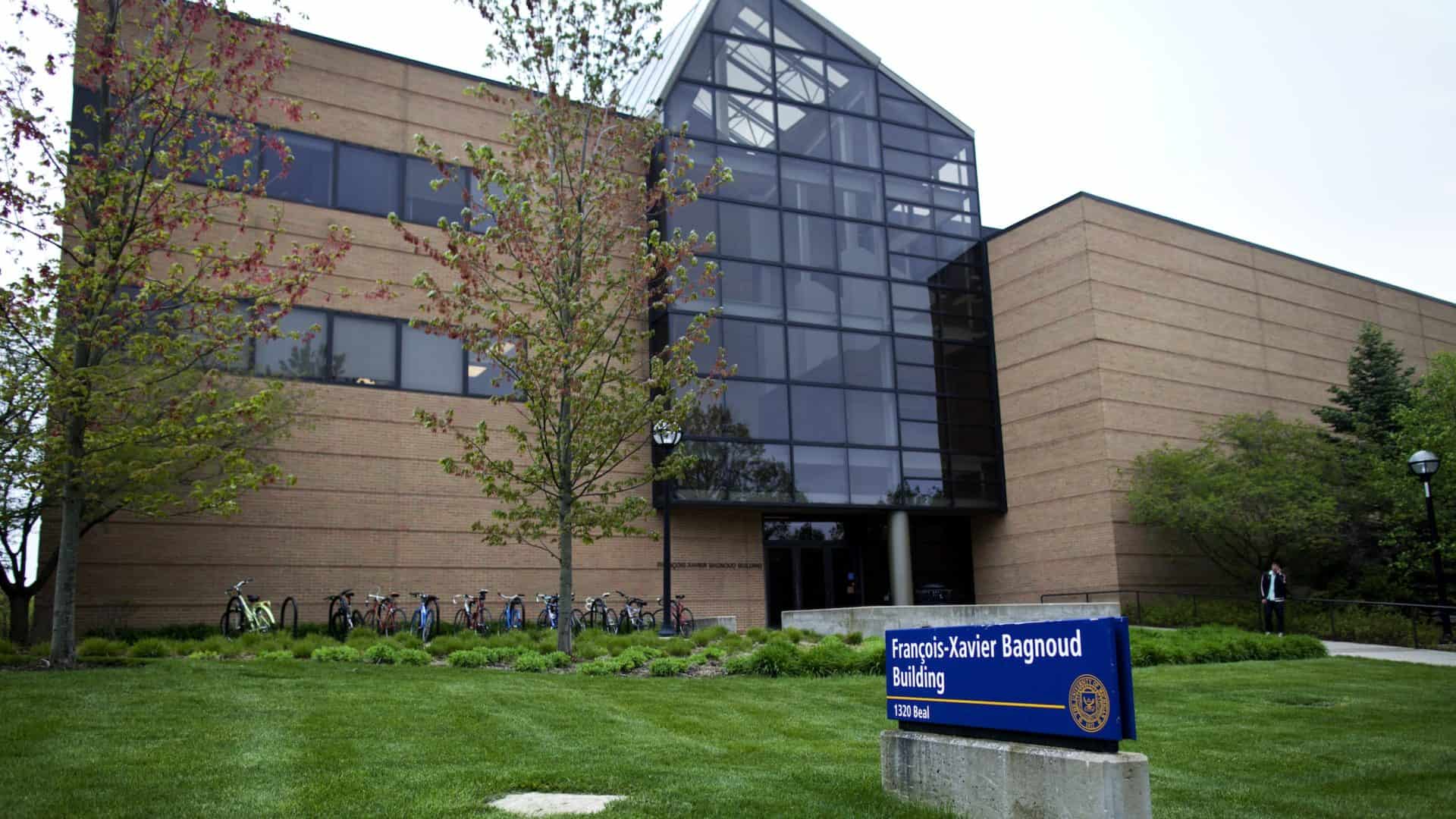
The FXB Building at the University of Michigan
In 1989, the FXB Foundation decided to finance the construction of a new building on the university campus: the FXB Building. The building will house research laboratories, classrooms, offices, a conference room and a library.
Located southeast of the FXB Building, the Wave Field is a memorial dedicated to François-Xavier Bagnoud and is a real art work. This earth sculpture, representing a field of waves, changes over the course of the day due to variations of light and shadows. It was designed and directed by Maya Lin, a renowned artist who created the Vietnam Veterans Memorial in Washington, D.C., as well as the Civil Rights Memorial in Montgomery, Alabama.
François-Xavier Bagnoud lived a life of enthusiasm, generosity, altruism and humble heroism, and he is honored in all the rooms of the building that bear his name and the inspiring legacy that he leaves behind him..
FXB Flight Vehicle Institute
Since 1991, the FXB Foundation has also funded FXB scholarships for graduate students in aerospace. In 1998, she created the FXB Chair in Aerospace Engineering, specializing in the study of vertical flights.
In 1999, the Rotary and Fixed Wing Air Vehicle Design Center was established. Its aim is to develop low-cost, optimised air vehicles that offer a reduced level of noise and vibration, as well as good damage tolerance.
All of these programs were consolidated in 2006 within the FXB Flight Vehicle Institute, which is part of the University of Michigan.
FXB Aerospace Award
From 1992 to 1999, the FXB Aerospace Prize was awarded every two years to honour the memory and ideals of François-Xavier Bagnoud. He rewarded the most significant contributions to the advancement of aerospace in the service of humanity.
The first edition of this award was awarded in 1993 to Dr. William H. Pickering for his critical work on understanding the planetary system. In 1995, the Apollo programme received the second award in recognition of its advances in making travel to the Moon possible. The award funds were used to fund six research awards to support human flight work.
In 1997, Joseph E. Sutter, Kenneth F. Holtby, Everette Webb and Robert A. Davis were rewarded for their major contribution to the design and development of the Boeing 747. Finally, in 1999, Yuri P. Semenov, Anatoly I. Kiselev, Gai I. Severin and Petr I. Klimuk were honoured for their role in the Mir station project, which has made an essential contribution to aerospace research since its launch.
In addition, FFXB supported the aeronautics sector through various contributions:
In Switzerland, in 1991, the FXB Foundation offers an infrared night vision system to Air-Glaciers to improve the efficiency and safety of night emergency helicopter flights.
In Switzerland, in 1992, the FXB Foundation awarded a scholarship to Benoît Darbellay to obtain his helicopter certificate. Benoît was a pilot at Air-Glaciers until his tragic death in 2005.
In Africa, in 1992, two Cessna twin-engined aircraft were offered to Amref (African Medical Research Foundation) to facilitate the movement of medical teams, vaccination campaigns and emergency evacuations into the bush.